

ITU-T Standardizes Framework of Low-Latency and Energy-Efficient Networks to Support the AI Era
Seven Japanese companies collaborate to promote global adoption of All-Photonics Network
August 21, 2026
August 21, 2026 – KDDI Corporation, NTT, Inc., 1Finity Inc., a Fujitsu company and leading provider of global network solutions, NEC Corporation, Rakuten Mobile, Inc., Oki Electric Industry Co., Ltd., and Sumitomo Electric Industries, Ltd. today announced that the framework of low-latency and energy-efficient networks to support the AI era has been approved as an international standard by the International Telecommunication Union Telecommunication Standardization Sector (ITU-T) on August 13, 2026 [1].
This framework will contribute to the realization of All-Photonics Network (APN), a strategic field under the "Strategy for Realizing Next-Generation Information and Communication Infrastructure to Support AI Society - Beyond 5G Promotion Strategy 2.0 -" promoted by Japan’s Ministry of Internal Affairs and Communications.
APN is expected to be deployed globally as a foundational network technology for next-generation services, including physical AI, because it enables high-capacity, low-latency, and energy-efficient communications and supports real-time processing of data obtained from sensors and robots in remote locations.
Toward this goal, the IOWN Global Forum, an organization dedicated to driving the widespread adoption of APN-based next-generation communication infrastructure, is developing common technical documents on APN architecture and functional requirements. In parallel, research and development on photonic network federation technology, which enables stable interconnection among APNs operated by different providers [2], is also underway to develop interconnection methods and evaluate them using actual equipment. However, achieving global-scale interoperability and adoption, including among operators, countries or regions outside these initiatives, requires establishing a common framework based on broad international consensus.
To address this challenge, Japanese telecommunications operators and equipment manufacturers have collaborated to lead the development of this framework. Now standardized as Recommendation ITU-T Y.3335, the framework defines the network configurations and technical requirements for establishing low-latency, energy-efficient communication paths across different operators [3]. It systematically organizes the accumulated knowledge of APNs and research outcomes on photonic network federation technology in a manner independent of any specific organization or implementation method. The approval from ITU-T provides a common framework for APN to be shared globally, making it easier to build APN services spanning multiple operators and enabling the use of high-speed, energy-efficient communication services even across geographically distributed sites.
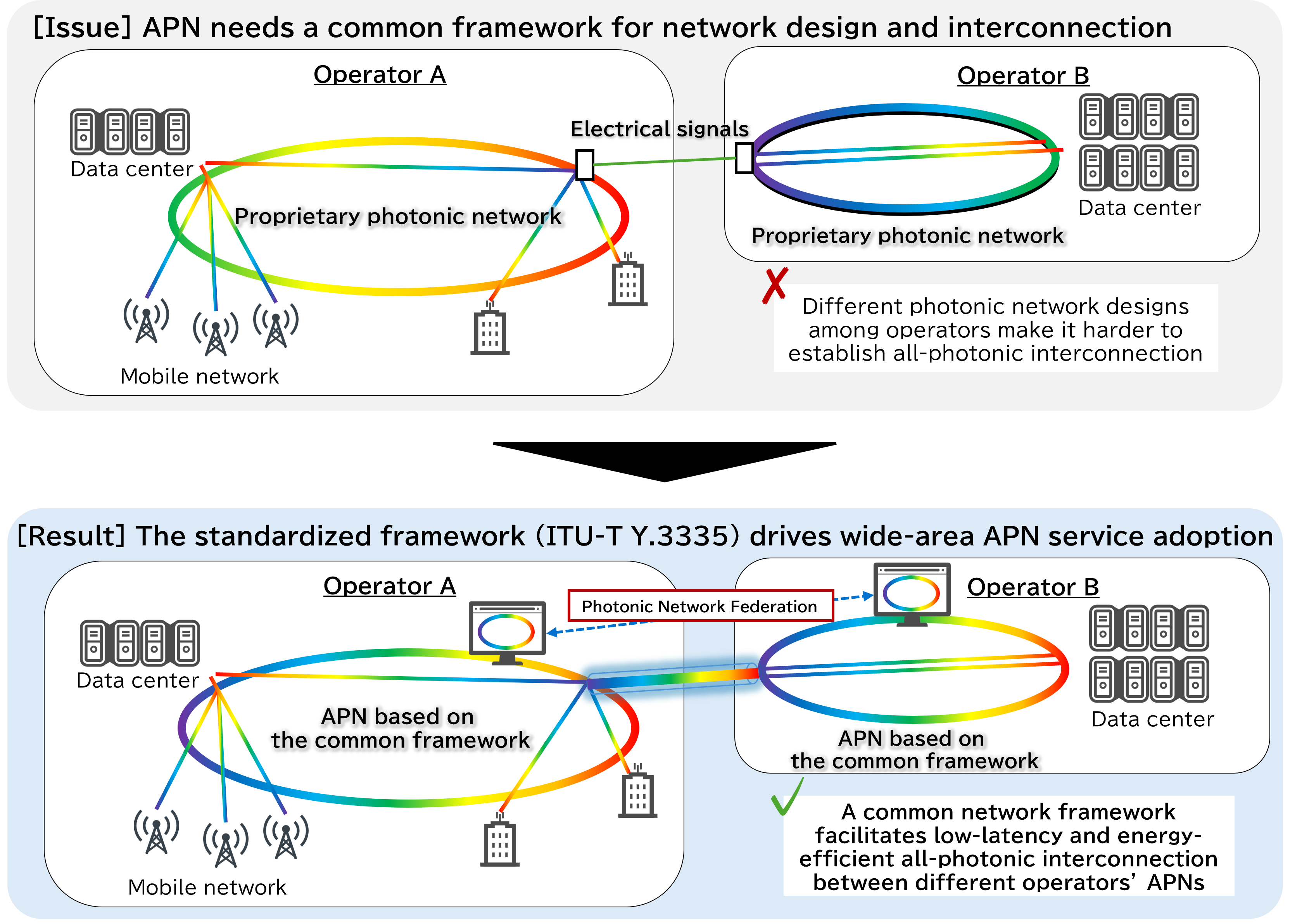
Conceptual Use of the Framework for APN Adoption
The seven companies will continue to promote standardization activities in Japan and overseas by leveraging network technologies and standardization expertise cultivated in Japan. Within ITU-T, they are also contributing to the development of a Recommendation on functional architecture for low-latency and energy-efficient networks, targeted for October 2028, and will continue contributing to the global adoption of APN to support the AI era.
Notes
- [1] KDDI Corporation, NTT, Inc., 1Finity Inc., NEC Corporation, and Rakuten Mobile, Inc. conducted this work as part of the commissioned research “Research and Development of All-Photonics Network Common Infrastructure Technology” (JPJ012368C09001) under the “Innovative ICT Fund Projects for Beyond 5G/6G” by National Institute of Information and Communications Technology (NICT), Japan.
- [2] News release dated October 25, 2024 : Joint proposal by NTT, KDDI, Fujitsu, NEC, and Rakuten Mobile adopted as Japan's Ministry of Internal Affairs and Communications/NICT's "Innovative ICT Fund Projects for Beyond 5G/6G" for social implementation and overseas expansion oriented strategic program (common infrastructure technology establishment)
- [3] Recommendation ITU-T Y.3335 (08/2026): Framework of low-latency and energy-efficient networks.