

Seven organizations launch development of next-generation distributed computing platform for practical quantum computing applications
October 26, 2026
October 26, 2026 - Tokyo, Kawasaki and Nagoya, Japan – Nautilus Technologies, Inc., Quanmatic Inc., GHELIA Inc., 1Finity Inc., a Fujitsu company and leading global network solutions provider, Internet Initiative Japan Inc. (IIJ), Waseda University, and Tokai National Higher Education and Research System, Nagoya University, have begun developing a next-generation distributed computing platform designed to support the practical application of distributed quantum computing. Development commenced on September29, 2026.
The platform will connect quantum clusters comprising multiple quantum computers with clusters of Tsurugi, a next-generation high-speed relational database, through an ultra-low-latency optical network, enabling the resources to be used as an integrated computing environment.
The seven organizations aim to expand quantum computing capacity while enabling integration with existing business systems. Through the platform, they will help solve complex optimization problems in a wide range of industries, including the optimization of electricity resources and AI inference resources, as well as applications in the automotive, financial, manufacturing and construction sectors.
The development is being conducted with support from the New Energy and Industrial Technology Development Organization (NEDO) under its Post-5G Information and Communication Systems Infrastructure Enhancement Research and Development Project and the initiative to accelerate the development and demonstration of next-generation quantum computers for solving social issues. The funded research and development theme is “Research and development of a real-time combinatorial optimization platform for AI inference tasks in wide-area Watt-Bit coordination.”
Background
Quantum computers are expected to provide new ways of solving complex combinatorial optimization problems, including electricity supply-and-demand balancing, production planning and financial portfolio optimization.Their use in business operations has nevertheless remained limited due to constraints on the scale of calculations and difficulties in connecting quantum computers with existing business systems.
To address these challenges, the seven organizations will develop a next-generation distributed computing platform integrating four key technologies, with a view to supporting business operations that require high reliability.
Key technologies under development
1. Quantum clusters for large-scale quantum computing
Distributed quantum-computing technology will link multiple quantum computers to expand computational scale to the level of hundreds of thousands of qubits. The project aims to enable rapid solutions to large-scale, real-world business problems.
2. Integration platform connecting quantum computing with business systems
The organizations will build a platform that bridges quantum computing and business data, enabling quantum-computing results to be incorporated smoothly into existing systems and operational processes.
3. Ultra-low-latency data-processing platform
The platform will use Tsurugi, a Japanese-developed, high-speed, open-source relational database, to accelerate the extraction, conversion and updating of data required for quantum computing and support large-scale data processing.
4. Long-distance optical network for real-time, wide-area data integration
The organizations will build a wide-area network connecting quantum computers and databases using optical network interface cards, or optical NICs, developed by 1Finity. This network will enable real-time data integration between geographically separated data centers.
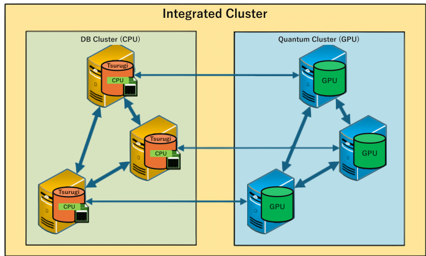
Conceptual architecture of the next-generation distributed quantum cluster
Roles of the participating organizations
- Nautilus Technologies : Overall project management and development of the distributed data platform using Tsurugi.
- Quanmatic : Development of distributed quantum-computing algorithms and implementation of the distributed quantum-computing system.
- GHELIA : Implementation of system-integration technology connecting distributed quantum computers with the data platform.
- 1Finity : Implementation of network technologies connecting resources within and between clusters, and provision of optical NIC equipment.
- IIJ : Procurement, construction and operation of the server environment used by the project at IIJ’s Shiroi Data Center Campus in Shiroi, Chiba Prefecture, Japan.
- Waseda University : Research and development of distributed quantum-computing algorithms.
- Nagoya University : Research and development of distributed indexing technology.
Future plans
The organizations will use the next-generation distributed computing platform to optimize electricity, communications and computing resources and expand the use of quantum computing across industries. The following applications are envisaged.
Use case 1: Wide-area optimization platform for Watt-Bit coordination
The organizations will develop a wide-area infrastructure that optimally allocates electricity, computing and communications resources across society in response to rapidly increasing demand for AI inference and the diversification of electricity generation, supply and distribution.
The platform will integrate and analyze a wide range of real-time data, including renewable-energy output, electricity prices, network utilization and GPU operating status. Through the efficient use of limited resources, the project aims to maximize value across society.
Tokyo Electric Power Company Holdings, Chubu Electric Power and Kyushu Electric Power are participating in or considering participation in this initiative. Integration with wide-area network services has also been confirmed.
By around 2030, the organizations aim to offer a large-scale platform on a software-as-a-service basis, contributing to the stabilization of AI inference costs and more efficient electricity use.
Use case 2: Local optimization platform for Watt-Bit coordination
As demand for AI increases, the efficient utilization of costly GPU resources has become an important challenge.
The platform will dynamically allocate GPU resources among multiple users and services. By selecting the most suitable GPU according to utilization conditions, the organizations aim to improve AI performance while reducing costs and making effective use of limited computing resources.
The technology is also expected to work with the wide-area optimization platform described above, enabling more efficient operation of computing resources.
Use case 3: Expanded application of quantum computing across industries
The platform will support the application of quantum computing in fields where technical constraints have previously made its use difficult.
Potential applications include energy-management optimization in the automotive sector, portfolio optimization in the financial sector, production-planning in manufacturing, and workforce-allocation and structural-design optimization in construction.
Through these applications, the organizations aim to provide new quantum-computing-based approaches to complex optimization problems that are difficult to solve with conventional computing methods.
Comments from companies cooperating in the development of the wide-area Watt-Bit coordination platform
Hiroshi Okamoto, Senior Fellow, Tokyo Electric Power Company Holdings, Inc., Visiting Professor, GX Strategy Promotion Center, The University of Tokyo, comments:
With the advancement of AI, the resources required by society are evolving beyond energy or information alone toward the integrated use of energy, information and computing.
This project represents an advanced initiative to combine quantum computing, data platforms and communications networks so that geographically distributed resources can function as if they were a single, large-scale intelligence.
If this direction continues to develop, it could represent an important step toward an era in which the entire nation functions as a distributed, massively parallel computing environment, enabling optimization and coordination beyond improvements in the performance of individual computers. The distributed quantum-computing platform being pursued through this project is an ambitious effort to explore that potential.
Watt-Bit coordination should be viewed not merely as the integration of electricity and digital infrastructure, but as an evolution toward an intellectual foundation for society as a whole. There are high expectations that this initiative will open new possibilities and contribute to a sustainable and prosperous future through the integrated use of electricity, communications and computing resources.
Kazuhiro Nabeta, Director, Executive Vice President, General Manager of Group Business Promotion Department, and General Manager of Corporate Planning & Strategy Division, Chubu Electric Power Co., Inc., comments:
The practical application of distributed quantum computing will require not only advances in computing technology itself, but also the establishment of a comprehensive technological foundation encompassing data processing and system integration.
I expect this collaborative industry-academia project to translate research and development outcomes into real-world applications, thereby contributing to the advancement of electricity systems and the resolution of broader societal challenges, as well as to the creation of new industrial value.
Yoichi Otomo, Executive Officer & General Manager, Digital Transformation Dept., Tohoku Electric Power Co., Inc., comments:
Tohoku Electric Power provides infrastructure supporting AI development through its GPU cloud services and GPU housing services at the Miyagi AI Data Center.
Strengthening the competitiveness of AI infrastructure services will require the optimal operation of electricity, communications and computing resources as an integrated whole, including the wide-area, real-time allocation of AI processing to the most suitable locations and computing resources.
We hope that the outcomes of this project will enhance Tohoku Electric Power’s AI infrastructure services and, as a provider of both electricity and AI infrastructure, contribute to the real-world implementation of Watt-Bit coordination and greater industrial competitiveness in the Tohoku and Niigata regions.
Kenichi Honda, Corporate Executive Officer and General Manager, Information and Communications Division
Kyushu Electric Power Co., Inc. , comments:
As the introduction of renewable energy and growth in AI demand accelerate, Watt-Bit coordination, which optimizes electricity and computing resources in an integrated manner, is becoming increasingly important.
The development of a next-generation platform centered on Tsurugi and quantum clusters is expected to enable the real-time, wide-area allocation of resources and make a significant contribution to more efficient electricity systems and the development of a sustainable society.
About 1Finity
1Finity, a Fujitsu company, is a global provider of communications networks for our connected world. We uniquely combine technological leadership and expertise in open optical and wireless networking, network automation, and applied AI/ML to design, build, operate, and maintain critical digital communications network infrastructure. Collaborating closely with ecosystem partners, we deliver transformative outcomes for service providers and network operators, and enable them to lower TCO, improve network performance, and increase energy efficiency. For more information, visit www.1Finity.com
About IIJ
Founded in 1992, IIJ is one of Japan's leading Internet-access and comprehensive network solutions providers. IIJ and its group companies provide total network solutions that mainly cater to high-end corporate customers. IIJ's services include high-quality Internet connectivity services, systems integration, cloud computing services, security services and mobile services. Moreover, IIJ has built one of the largest Internet backbone networks in Japan that is connected to the United States, the United Kingdom and Asia. IIJ was listed on the Prime Market of the Tokyo Stock Exchange in 2022. For more information about IIJ, visit the IIJ Web site at https://www.iij.ad.jp/en/.
Press Contacts
1Finity.press@fujitsu.com
All company or product names mentioned herein are trademarks or registered trademarks of their respective owners. Information provided in this press release is accurate at time of publication and is subject to change without advance notice.